
Cast Iron Radiators: The Complete Buyer’s Guide
Estimated Reading Time: 18 minutes
Cast iron radiators are one of the best heating solutions you can put in a UK home. Choosing the right one can feel overwhelming. There are styles, sizes, column counts and finishes to think about, plus questions around heat output, energy efficiency, installation and running costs. This guide covers everything: from how cast iron radiators work and what they cost to which model suits your room and budget.
Browse our full range of traditional cast iron radiators to start exploring.
What Are Cast Iron Radiators?
Cast iron radiators are heating units made by melting iron and pouring it into moulds to create individual sections. Those sections then bolt together to form a complete radiator. They first appeared in the United States in the mid nineteenth century and became the dominant heating solution across Europe throughout the Victorian and Edwardian eras.
They’re still popular today, and for good reason. Cast iron is an exceptionally dense material. It holds heat well, releases it slowly and stays warm long after the boiler cycles off. That makes it a genuinely efficient option, not just a stylistic one.
Modern steel panel radiators took over in most new build homes during the twentieth century. But cast iron never went away. Period property owners, interior designers and renovation specialists have always valued its heat retention, its distinctive look and its extraordinary lifespan.
What Do Cast Iron Radiators Look Like?
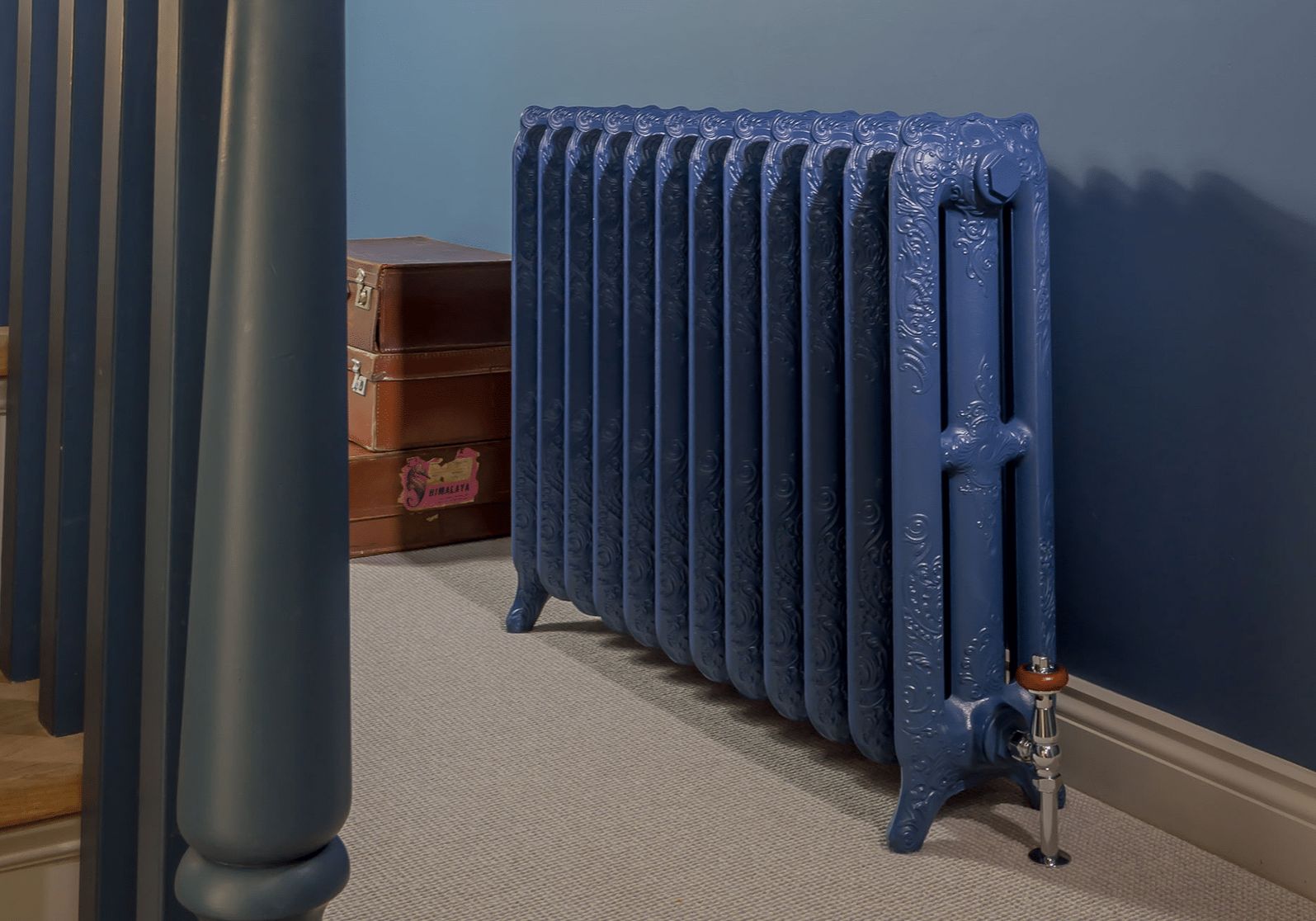
Cast iron radiators come in a wide variety of styles. From highly ornate Victorian designs to clean, minimal modern profiles, there’s something for virtually every interior.
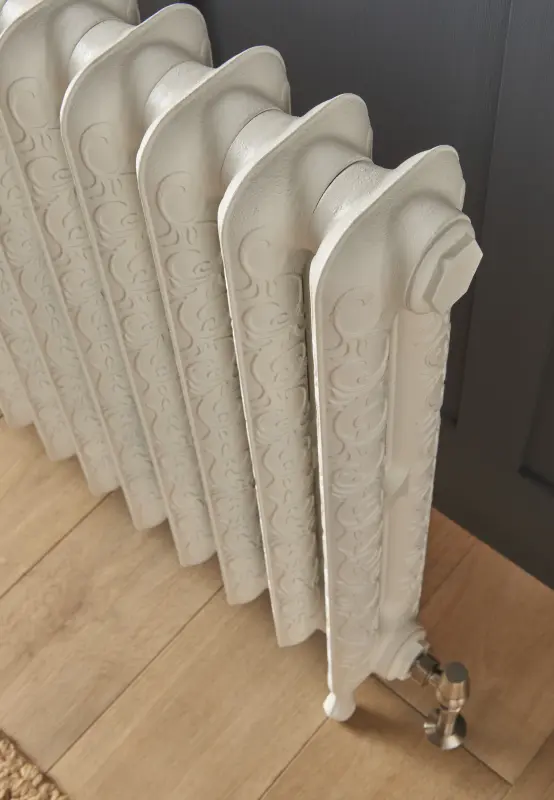


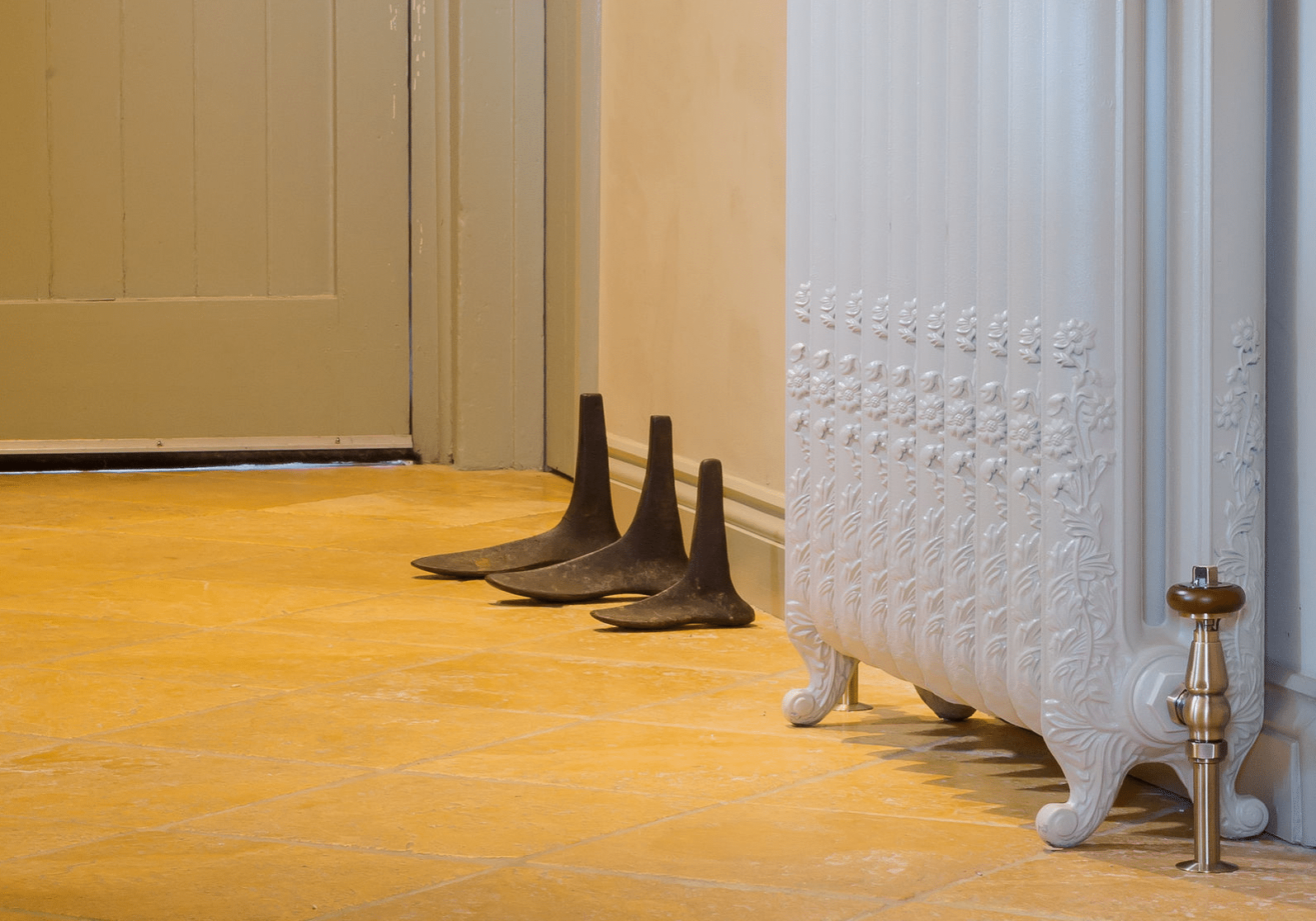
White cast iron radiators are among the most popular choices. Clean, timeless and versatile. We can finish virtually any model in white or off white tones.
How Do Cast Iron Radiators Work?
Cast iron radiators warm a room through a combination of radiant heat and convection. Hot water from the boiler circulates through the sections. The cast iron absorbs that heat and radiates it outward into the room. Air around the columns warms up and rises, and that creates a convective current that carries warmth throughout the space.
The real advantage is heat retention. Cast iron is so dense that it takes longer to heat up. But it takes much longer to cool down too. Once your boiler switches off, the radiator keeps emitting warmth for a significant time. Your room stays comfortable for longer without the boiler constantly running.
Worth knowing: old cast iron radiators work in exactly the same way. A reclaimed Victorian radiator, properly restored and installed, performs just like a new one.
Are Cast Iron Radiators Efficient?
Cast iron radiators retain and release heat more effectively than thin steel panel radiators. Their thermal mass means the boiler can run for a shorter period to reach the same room temperature.
Advantages:
- Superior heat retention: warmth continues well after the boiler cycles off
- Long lifespan: reduces the environmental cost of manufacture and disposal
- Works with most heating systems, including heat pumps at lower flow temperatures
- Add or remove sections to adjust output as your needs change
- No internal polymer coatings to degrade over time
Disadvantages:
- Heavier than steel or aluminium, so installation is more complex
- Slower to respond to thermostat adjustments
- Higher upfront cost than standard panel radiators
But over a full product lifecycle? Cast iron’s longevity and heat retention make it a genuinely sustainable choice.


How Are Cast Iron Radiators Made?
Each section starts as molten iron poured into a shaped mould. Once cooled, sections are cleaned, inspected and bolted together using nipples, then sealed with EPDM rubber gaskets.
At Paladin, we’re the only manufacturer in the UK supplied by a dedicated foundry, producing exclusively for our own range. We don’t use shared, multi product foundries. So our casting moulds stay sharp and our ornate detail stays crisp, year after year.
After assembly, we pressure test each radiator to confirm there are no leaks. Then the finishing goes on by hand. Whether that’s a standard colour, a Farrow and Ball shade, a hand finished antiqued effect or a brilliant mirror polish, every radiator is prepared, painted and checked individually before it leaves the factory.
What Types of Cast Iron Radiators Are Available?
Cast iron radiators fall into several broad categories.
Victorian: Highly ornate with decorative caps and scrollwork. The Kensington, Oxford and Bartholomew sit here.
Edwardian and traditional: Refined but less elaborate. The Montpellier and Churchill are good examples.
Georgian-inspired: Clean, columned profiles. The Neo Georgian 4 Column and Neo Georgian 6 Column.
Contemporary: Modern proportions in cast iron. The Clarendon, Victoriana range and Pimlico.
Tall models: The Saint Paul (800mm), 960mm Neo Georgian variants and Oxford 765mm.
Electric cast iron radiators: A standalone electric option for rooms where wet plumbing isn’t practical. Our electric cast iron radiators guide covers these in full.
CORE range: The Neo Georgian 4 Column CORE is a streamlined option well suited to renovation and new build projects.

What Should You Look For When Buying Cast Iron Radiators?
There’s more to picking the right radiator than finding one you like the look of. Here’s what to check.
Buyer checklist:
- BTU output: Does the radiator deliver enough heat for your room? Use a heat calculator before you buy.
- Room dimensions: Length, width and ceiling height all affect how much output you need.
- Height options: Taller sections put out more heat. Check what heights are available for your chosen model.
- Width: Determined by section count. More sections means more output and more wall space.
- Number of columns: More columns means a deeper radiator with higher output per section.
- Finish: Matt, gloss, polished, antiqued or custom colour match.
- Colour: Standard range, Farrow and Ball, Little Greene, Edward Bulmer or a bespoke match.
- Valve compatibility: Check the connection size and angle before ordering.
- Warranty: Paladin radiators carry a 10 year guarantee. Check what any other manufacturer offers.
- Build quality: Look for sharp mould detail, clean joints and consistent finishing.
What Size Cast Iron Radiator Do I Need?
The size you need depends on your room’s heat requirement, measured in BTUs (British Thermal Units). A large, poorly insulated room needs more output. A small, well insulated room needs far less.
Use our heat calculator for a precise figure. The table below gives approximate BTU requirements for typical UK rooms, based on standard 2.4m ceiling heights and average insulation.
| Room Type | Approximate Size | Approximate BTU Required |
|---|---|---|
| Small bedroom | 8 to 10m² | 2,000 to 3,000 |
| Medium bedroom | 12 to 16m² | 3,000 to 4,500 |
| Living room (small) | 16 to 20m² | 4,500 to 6,500 |
| Living room (large) | 25 to 35m² | 7,000 to 12,000 |
| Kitchen or kitchen diner | 18 to 25m² | 5,000 to 8,000 |
| Bathroom | 5 to 10m² | 1,500 to 3,000 |
| Hallway | Varies | 2,000 to 5,000 |
These are approximate. Rooms with high ceilings, large windows or solid stone walls will need more. Our team is happy to help you work it out before you order.
What Comparisons Matter Most When Choosing Cast Iron Radiators?
Here’s how cast iron stacks up against the main alternatives.
Cast iron vs steel panel radiators:
| Factor | Cast Iron | Steel Panel |
|---|---|---|
| Heat retention | Excellent | Poor |
| Response time | Slower | Faster |
| Lifespan | 50+ years | 10 to 20 years |
| Appearance | Distinctive | Plain |
| Weight | Heavy | Light |
| Upfront cost | Higher | Lower |
Cast iron vs aluminium radiators:
| Factor | Cast Iron | Aluminium |
|---|---|---|
| Heat retention | Excellent | Poor |
| Response time | Slower | Very fast |
| Lifespan | 50+ years | 20 to 30 years |
| Corrosion resistance | Good with treatment | Excellent |
| Style options | Wide | Limited |
Cast iron vs designer and panel radiators
Designer radiators offer more format freedom: vertical, ultra flat, curved. Cast iron wins on longevity, heat retention and period character. For a modern home where striking profiles come first, a designer radiator may be a better fit.
Which Cast Iron Radiators Are Best For Different Rooms?
Cast Iron Radiators for Living rooms: Large, statement models work well here. The Oxford, Montpellier or Bartholomew deliver strong output and make a real visual impact. Multi section configurations suit longer walls well.
Cast Iron Radiators for Bedrooms: Mid-height models like the Victoriana 3 Column or Pimlico keep heat gentle and steady. The slow release nature of cast iron suits a sleeping environment.
Cast Iron Radiators for Bathrooms: Electric cast iron radiators are the most practical choice where a wet system connection isn’t possible. Plumbed cast iron radiators can work in bathrooms too, with appropriate valves and pipework, as long as IP zone requirements are met.
Cast Iron Radiators for Kitchens: Cast iron suits large kitchen diners well. Keep valve placement practical and choose a finish that’s easy to wipe down.
Cast Iron Radiators for Hallways: Tall, narrow configurations like the Saint Paul or tall Neo Georgian variants suit hallways with limited wall width but decent ceiling height.
Cast Iron Radiators for Home offices: Steady background heat suits focused work. A smaller cast iron radiator set to a consistent temperature is ideal.
Cast Iron Radiators for Conservatories: Insulation is often poor. Check your BTU requirements carefully. An electric cast iron model might be more practical if the conservatory isn’t connected to the wet system.

Which Cast Iron Radiators Are Best For Different Applications?
- Period properties: Ornate models like the Kensington, Oxford or Bartholomew are designed for Victorian and Edwardian homes. The detailing reflects original period ironwork without being a direct replica.
- Heritage renovations: The Paladin range is widely used in listed building and conservation area projects. Bespoke colour matching and designs that suit the period make sympathetic refurbishment straightforward.
- Modern homes: Cleaner profiles like the Clarendon, Victoriana 4 Column or Neo Georgian 4 Column sit comfortably in contemporary interiors.
- Large rooms: Multi section configurations of taller models like the Oxford 765mm or Neo Georgian 960mm deliver high output without needing multiple separate radiators.
- Small rooms: Fewer sections of a shorter model often do the job. The Pimlico or Elizabethan work well in compact spaces.
- Heat pump systems: Cast iron works well at lower flow temperatures. Its large surface area compensates for the reduced water temperature, making it a natural fit for low temperature systems.
Are Cast Iron Radiators Compatible With Modern Heating Systems?
Cast iron radiators are compatible with combi boilers, conventional boilers, system boilers and heat pumps. There are no fundamental compatibility issues. But a few points are worth checking before you install.
Combi boilers: Cast iron works fine with a combi. Older combi boilers with smaller flow rates may need checking by a heating engineer to confirm they can handle the higher water volume.
Conventional and system boilers: An ideal pairing. Cast iron’s high thermal mass suits these systems well. It’s a combination with a long track record in UK homes.
Heat pumps: Cast iron is well suited to heat pump systems. At lower flow temperatures, its large surface area radiates heat effectively. You may need more sections or a taller model compared to a conventional boiler setup.
Low temperature systems: Cast iron performs particularly well here. Its surface area and thermal mass make it more effective than thin steel panels at lower operating temperatures.
How Much Do Cast Iron Radiators Cost?
Cast iron radiator prices are per section. Multiply the per section price by the number of sections you need for your room, then add your chosen finish and any accessories.
The table below shows per section retail prices from our approx April 2026 price list. All prices include VAT.
| Model | Height (mm) | Price Per Section |
|---|---|---|
| Elizabethan | 500 | from £24.62 |
| Elizabethan | 650 | from £26.77 |
| Elizabethan | 750 | from £28.56 |
| Victoriana 3 Column | 450 | from £28.60 |
| Victoriana 3 Column | 645 | from £32.15 |
| Victoriana 3 Column | 745 | from £35.09 |
| Pimlico | 460 | from £29.20 |
| Pimlico | 660 | from £31.85 |
| Pimlico | 760 | from £33.92 |
| Neo Georgian 4 Column | 360 | from £28.64 |
| Neo Georgian 4 Column | 505 | from £35.09 |
| Neo Georgian 4 Column | 660 | from £43.12 |
| Neo Georgian 4 Column | 760 | from £50.21 |
| Neo Georgian 4 Column | 960 | from £62.11 |
| Neo Georgian 6 Column | 505 | from £50.21 |
| Neo Georgian 6 Column | 660 | from £64.39 |
| Neo Georgian 6 Column | 960 | from £96.22 |
| Kensington | 580 | from £38.78 |
| Kensington | 750 | from £46.62 |
| Kensington | 780 | from £48.17 |
| Sloane | 450 | from £40.67 |
| Sloane | 750 | from £61.63 |
| Clarendon | 440 | from £41.61 |
| Clarendon | 740 | from £64.13 |
| Victoriana 4 Column | 460 | from £28.60 |
| Victoriana 4 Column | 660 | from £32.15 |
| Victoriana 4 Column | 760 | from £37.45 |
| Victoriana 4 Column | 813 | from £43.95 |
| Shaftsbury | 540 | from £48.48 |
| Shaftsbury | 740 | from £63.18 |
| Louis | 560 | from £49.05 |
| Louis | 760 | from £63.82 |
| Piccadilly | 460 | from £51.80 |
| Piccadilly | 660 | from £67.89 |
| Piccadilly | 760 | from £72.10 |
| Bartholomew | 570 | from £53.17 |
| Bartholomew | 740 | from £67.58 |
| Churchill | 350 | from £53.79 |
| Montpellier | 590 | from £56.00 |
| Montpellier | 790 | from £73.48 |
| Gatsby | 570 | from £61.08 |
| Gatsby | 740 | from £73.13 |
| Oxford | 470 | from £65.00 |
| Oxford | 570 | from £74.67 |
| Oxford | 765 | from £89.16 |
| Saint Paul | 800 | from £110.67 |
Finishing costs are per section on top of the base price:
| Finish | Cost |
|---|---|
| Custom painting (Paladin metals range, RAL or BS colours) | From £9.91 per section |
| Farrow and Ball, Little Greene or Edward Bulmer | From £18.59 per section |
| Hand finished antiqued effect | £18.59 per section |
| Hand finished highlight effect | £37.54 per section |
| Industrial or burnished finish | £37.16 per section |
| Hand polished | £49.55 per section |
| Satin or mirror polished | £59.15 per section |
Note: burnished and polishing services aren’t available on the Neo Georgian 4 Column 960mm, Neo Georgian 6 Column 960mm or Saint Paul.
New vs reclaimed
Reclaimed cast iron radiators can look cheaper upfront. But they often need significant restoration work and won’t carry a manufacturer’s guarantee. New radiators give you verified heat output data, consistent finishing and a full warranty.
Installation costs
Professional installation by a Gas Safe registered heating engineer is strongly recommended. Costs vary by location and the complexity of your pipework. See our cast iron radiators for all budgets guide for a more detailed cost breakdown.
Cast Iron Radiator Installation Guide
Installation follows a clear process. But it needs careful planning before you start.
Key steps:
- Calculate your BTU requirement and confirm the correct model and section count.
- Identify your pipe centres. These vary by model, so check the product specification.
- Decide on your pipework entry point: floor entry, skirting or surface mounted.
- Mark wall stay positions and fix back plates securely to the wall.
- Assemble the radiator if not yet assembled. Check nipple tightness and joint seals.
- Position and connect to the pipework using appropriate valves.
- Fill the system and bleed the radiator before a full pressure test.
Floor loading: Cast iron radiators are heavy. A fully assembled multi section radiator weighs considerably more than a steel panel equivalent. Confirm your floor can take the load before you fix anything.
Wall mounting: Wall stays are essential for stability. We stock standard and luxury wall stays in a range of finishes to match your valves.
Professional installation: Use a Gas Safe registered engineer. Our installation guide covers the full process, including pipe centres and connection options.
Which Valves Are Best For Cast Iron Radiators?
Traditional style valves complement cast iron radiators well. Both manual and thermostatic options work, and we offer a comprehensive range in multiple finishes.
Thermostatic radiator valves (TRVs): These give you individual room temperature control. They’re the more energy efficient choice for most installations. Paladin TRV sets include the Canterbury (from £89.67), Belgravia (£141.58), Buckingham (from £146.30) and Highgrove (£141.58).
Manual valves: Simple and reliable. Good for rooms where you want a consistent heat level without adjustment. Manual options include the Kingsbury (£122.70), Chelsea (£84.95), Daisy Wheel (£84.95), Lambeth (£56.63) and Eton (£84.95).
Angle or straight: Angled valves suit floor entry pipework. Straight valves suit side entry configurations. Corner valves are available for tight or awkward spots.
Finishes: Antique brass, brushed nickel, chrome, black nickel, Old English brass and polished brass. There’s a finish to match virtually any radiator or room scheme.
What Problems Can Cast Iron Radiators Develop?
Cast iron radiators are built to last. But they can develop issues over time, and it’s worth knowing what to look for.
Cold spots: Usually caused by trapped air. Bleed the radiator to fix it.
Sludge: Magnetite deposits from corrosion elsewhere in the system can accumulate inside the radiator and reduce output. Power flushing removes it effectively.
Leaks: These can develop at section joints or valves. Joint leaks may need a plumber to isolate and renipple the affected sections. Valve leaks are often fixed by tightening the gland nut or replacing the valve.
Corrosion: Surface rust is cosmetic and treatable. Internal corrosion is a different matter and usually points to an uninhibited heating system. Keep inhibitor levels topped up to prevent it.
Paint damage: Flaking or chipping paint is common on older radiators. Strip the finish, prime and repaint. The section below on painting covers what to use.
How Do You Maintain Cast Iron Radiators?
Cast iron radiators don’t need much attention. A few routine checks each year will keep them in good shape.
Bleeding: Bleed your radiators once a year or whenever cold spots appear at the top. Open the air vent with a bleed key until water appears, then close it.
Cleaning: Dust and vacuum between the sections regularly. Wipe the outer surface with a damp cloth. Avoid abrasive cleaners.
Painting: You can repaint at home or have it done professionally. Strip any loose paint first, apply a suitable primer and finish with a heat resistant radiator paint. Our full radiator maintenance guide has step by step instructions.
Inhibitor: Keep your central heating inhibitor at the correct concentration. Check it annually, especially after topping up the system.
Rust prevention: Address surface rust quickly. Sand back to bare metal, prime and repaint. Leave it and it can penetrate deeper over time.


What Is The Best Paint For Cast Iron Radiators?
The best paint for cast iron radiators is a specialist radiator paint built to withstand the temperatures a central heating system produces. Standard wall paint isn’t suitable. It’ll discolour and crack.
Options to consider:
- Water based heat resistant radiator paint: Lower odour, quick drying and available in a wide colour range. A good choice for most home applications.
- Oil based radiator enamel: A harder, more durable finish. It takes longer to dry and has stronger fumes, but it lasts well.
Spray paint: Good for achieving an even finish in areas between sections that are hard to reach.
Preparation matters as much as the paint itself. Sand back any loose or flaking paint, clean the surface thoroughly and apply a suitable primer before your topcoat. We offer a full custom painting service if you’d rather leave it to us.
Start typing your content here.
What Alternatives Should You Consider?
Cast iron radiators aren’t right for every situation. Here’s what else is worth considering.
Steel column radiators: Lighter and cheaper than cast iron. A similar visual profile but without the heat retention or lifespan.
Aluminium radiators: Very fast to heat and cool. Useful where rapid temperature response matters but not well suited to period interiors.
Designer radiators: Vertical panels, flat panels, curved designs. More format freedom but less suited to period properties.
Panel radiators: The most common and most affordable option. Functional, but visually plain with no period character.
Green Flags vs Red Flags When Buying Cast Iron Radiators
| Green Flags | Red Flags |
|---|---|
| Verified BTU output data available | No heat output data provided |
| Long manufacturer guarantee (10 years) | Short or no warranty offered |
| Sharp, crisp casting detail | Rough or blurred mould detail |
| Consistent, even finish | Uneven paint or visible surface defects |
| Reputable UK manufacturer | No clear country of manufacture |
| Sections individually pressure tested | No testing information available |
| Dedicated in house factory | Mass production multi product factory |
| Clear section by section pricing | Vague or bundled pricing |
Frequently Asked Questions
Are cast iron radiators worth it?
Cast iron radiators are worth it for homeowners who want long term performance, a distinctive look and a sustainable heating solution. Their lifespan, heat retention and character make them a genuinely strong investment.
Why are cast iron radiators expensive?
Cast iron radiators are more expensive than steel panel radiators because the casting process is labour intensive, the raw materials are heavier and hand finishing takes significant time. You’re paying for craftsmanship and longevity, not just a heating appliance.
Do cast iron radiators save energy?
Cast iron radiators are good at retaining heat after the boiler cycles off. That slow release means the boiler runs less often to maintain the same temperature, which can reduce your energy use over time.
How long do cast iron radiators last?
Cast iron radiators are exceptionally long lasting. With proper maintenance, a lifespan of 50 years or more is realistic. Original Victorian cast iron radiators are still in active use in UK homes today.
Are cast iron radiators suitable for heat pumps?
Cast iron radiators are suitable for heat pump systems. Their large surface area compensates for the lower flow temperatures heat pumps use, delivering effective warmth at 45 to 55 degrees rather than the 70+ degrees a conventional boiler produces.
Can cast iron radiators rust?
Cast iron radiators are susceptible to surface rust if the paint is damaged or if the central heating system lacks adequate inhibitors. Surface rust is treatable. Maintaining inhibitor levels and touching up paint when needed keeps it in check.
Can cast iron radiators be repainted?
Cast iron radiators are straightforward to repaint. Strip any loose paint, apply a primer and use a heat resistant radiator paint. We also offer a professional refinishing service for a result that matches the foundry finish.
Are cast iron radiators better than steel radiators?
Cast iron radiators are better than steel radiators on heat retention, lifespan and visual character. Steel radiators heat up faster and cost less upfront. Which suits you better depends on your priorities.
Are cast iron radiators good for bedrooms?
Cast iron radiators are well suited to bedrooms. Their slow, steady heat release creates a comfortable, consistent temperature without the rapid cycling that cheaper radiators produce.
Can cast iron radiators be installed in bathrooms?
Cast iron radiators are suitable for bathroom installation, subject to IP zone requirements for heating safety. Electric cast iron radiators are a practical alternative where wet system installation is complicated.
Cast iron radiators are the most characterful and durable option available. They suit period and contemporary interiors, work with modern heating systems and carry a visual presence that no steel panel can match.
The right choice depends on your room size, BTU requirement, interior style and budget. Start with the heat output you need, choose the model and height that fits your wall space, then pick the finish that suits your home.
We’ve been hand-assembling and hand-finishing cast iron radiators in Lincolnshire for over two decades. We’re the only manufacturer in the UK supplied by a dedicated foundry. 18 designs to choose from, bespoke colour options including Farrow and Ball and Little Greene, and a 10-year guarantee on every radiator we make.
Ready to find the right radiator?
“I want to say thanks and how fantastic the radiators look along with the cast quality and the excellent painting and polishing finish. I now can’t wait to get them installed! Many thanks again for all your help and assistance.”
“Thank you for all your help, we will definitely recommend Paladin to anyone we know who is looking for cast iron radiators and will get in touch when we’re needing radiators for our ground floor.”