

2 Column vs 4 Column vs 6 Column Radiators: Which One Should You Choose?
Estimated reading time: 5 minutes
All three of these column radiators are cast iron. The only real difference is depth: how many columns run front to back through each section. That single number decides how far the radiator projects off the wall, how much heat it puts out and how much visual weight it brings to the room. A 2 column radiator sits close to the wall and suits tight spaces. A 6 column radiator does the opposite. It projects further but it heats a big, draughty room properly. A 4 column sits between the two, which is why it’s the depth most people end up choosing.
How does column depth affect heat output and wall space?
More columns means more metal and more surface area, so the radiator holds more water and gives off more heat for the same height and width. That extra performance has to come from somewhere, and it comes from depth. Roughly speaking, a 2 column radiator projects around 100mm off the wall, a 4 column around 145mm, and a 6 column closer to 190mm. So before you fall for a particular look, it’s worth checking the projection against your actual wall space, especially near doorways or narrow landings where a deep radiator can get in the way.
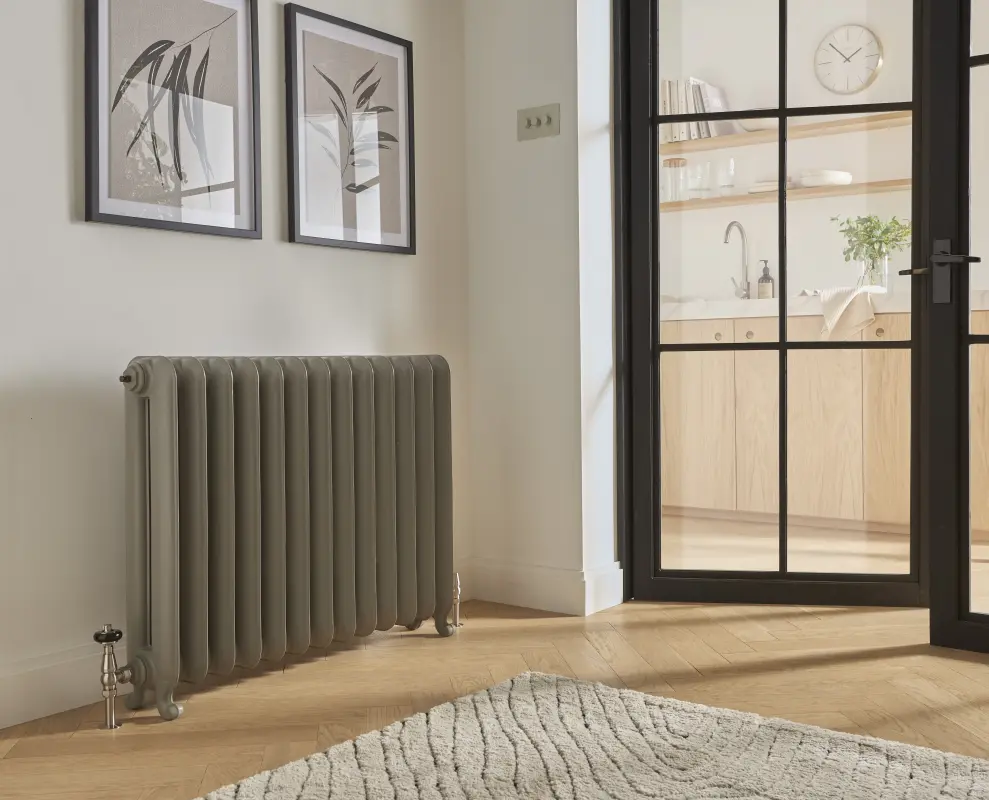
2 column radiators: strengths and impact
- The slimmest profile of the three, at around 100mm deep, clears doorways, narrow hallways and tight landings without a second thought.
- Lower output per section than a 4 or 6 column equivalent, but you can add more sections to make up the difference in a longer, shallower room.
- Models like the Bartholomew and Kensington come in this depth so you’re not choosing between slim and stylish.
- We hand assemble and pressure test every radiator at our Lincolnshire factory, whatever depth you choose.
- Because there’s less metal, it’s a little lighter to lift and fit than a deeper equivalent of the same height.
Impact: a slim radiator for a tight space, without giving up cast iron’s heat retention to get there.
4 column radiators: strengths and impact
- The most popular depth for good reason. Enough output for most living rooms and bedrooms, at a projection most walls can take comfortably.
- Around 145mm deep, it sits further out than a 2 column but rarely causes a problem in a normal room.
- Our Neo Georgian is a good example. The same model as the 6 column version, just built one depth shallower.
- Enough thermal mass to hold heat well after the boiler cycles off, without the extra weight and projection of a 6 column.
- Bespoke in height and section count, so a 4 column doesn’t mean a fixed size.
Impact: the depth that suits most rooms (most of the time) without needing to compromise on either heat or wall space.
6 column radiators: strengths and impact
- The highest output per section of the three, built for big rooms, high ceilings and older properties that lose heat fast.
- Around 190mm deep, so check your clearance carefully, particularly around doors, worktops or anywhere people walk close past it.
- The Neo Georgian 6 Column is our clearest example: same design, built deeper for the extra surface area.
- More metal and more water content, it holds heat for even longer once the boiler stops.
- Fewer, taller sections can often hit the BTU you need without stretching a radiator across an entire wall.
Impact: the output to heat a difficult room, in a footprint that’s still narrower than fitting two shallower radiators side by side.
Not sure which depth your room actually needs? Use our radiator configurator to work out the BTU, then call our team on 01205 280354 or email sales@paladinradiators.com to talk through column depth, section count and finish.
How do 2, 4 and 6 column radiators compare?
Here’s how the three depths stack up against each other.
| Feature | 2 Column | 4 Column | 6 Column |
|---|---|---|---|
| Typical wall projection | Around 100mm | Around 175mm | Around 250mm |
| Heat output per section | Lowest of the three | Higher | Highest |
| Best suited to | Hallways, cloakrooms, tight landings | Living rooms, bedrooms, most standard spaces | Large rooms, high ceilings, older solid-walled properties |
| Weight per section | Lightest | Heavier | Heaviest |
| Visual weight | Slim and understated | Solid, classic proportions | Chunky, a genuine focal point |
| Bespoke sizing and Farrow & Ball / Little Greene finishes | ✓ | ✓ | ✓ |
| Guarantee | 10 years | 10 years | 10 years |
Why does column depth matter more than just output?
It matters because getting it wrong in either direction causes a real problem, not just a small inconvenience. Go too shallow and you’ll need an unusually long run of sections to hit the BTU a big room needs, which eats into wall space you might want for furniture or windows. Go too deep in a tight hallway, and you’ll find yourself brushing past the radiator every time you walk through.
So the right depth isn’t really a style choice first. It’s a balance between the heat your room needs and the space you can actually give up to get it. Our radiator configurator helps with the output side of that equation, and our guide to standard radiator sizes covers how height, section count and column depth work together once you know the number you’re aiming for.
If you’re still weighing up styles more broadly, our guide to choosing a model by room goes through which depth and design tends to suit which space.
“I want to say thanks and how fantastic the radiators look along with the cast quality and the excellent painting and polishing finish. I now can’t wait to get them installed! Many thanks again for all your help and assistance.”
“Thank you for all your help, we will definitely recommend Paladin to anyone we know who is looking for cast iron radiators and will get in touch when we’re needing radiators for our ground floor.”